Elucidating circuit-level mechanisms connecting movement, pain, and opioid neuromodulation
The Mercer Lindsay Lab dissects how motor circuits and the brain's endogenous opioid system interact across the neuraxis — building the mechanistic foundation for new, non-addictive treatments for chronic pain.
Pain reshapes how we move, not just how we feel
Chronic pain is a pervasive, debilitating condition that arises from complex interactions between sensory input, motor output, and neuromodulatory signals.
Most pain research has focused on sensory pathways. But motor cortex corticofugal projections — best known for driving coordinated movement — can also produce potent pain relief when stimulated, an effect that depends on the brain's own endogenous opioid signaling. We investigate how motor circuit activity directly and indirectly modulates the pathways that drive the sensory, emotional, and cognitive dimensions of pain.
Three topics guide our work
Somatotopic Pain Circuits
How motor cortex → brainstem → thalamic pathways are organized by body-map position to shape descending pain control.
Opioid Receptor Architecture
Mapping μ, δ, κ, and nociceptin receptor expression across brainstem and forebrain circuits.
Neuromodulation & TMS
Engineering miniaturized transcranial magnetic stimulation devices to causally probe pain-relief circuits in mice.
From single synapse to whole-animal behavior
We combine viral circuit tracing, high-density Neuropixels electrophysiology, calcium imaging (two-photon, widefield one-photon, and miniscope), chemogenetic and optogenetic manipulation, in vivo pharmacology, and machine-learning-based behavioral tracking to link molecular mechanism to circuit function to behavior.
This multi-scale toolkit lets us test causal hypotheses — from receptor to reflex — in preclinical models of chronic pain.

Nicole Mercer Lindsay, PhD
Assistant Professor, Departments of Neurosurgery and Anesthesiology, Weill Cornell Medicine · Director of the Laboratory for Systems Neuroscience in Pain and Movement Circuitry
Dr. Mercer Lindsay's research trajectory has progressed from defining motor cortical output organization (PhD, UC San Diego, with David Kleinfeld), to mapping brainstem opioid receptor architecture (postdoc, Stanford & UNC Chapel Hill, with Grégory Scherrer and Mark Schnitzer), to uncovering causal circuit mechanisms of descending pain control using targeted neuromodulation and large-scale electrophysiology.
Interested in joining the lab?
We welcome inquiries from prospective postdoctoral fellows, graduate students, and undergraduates interested in systems neuroscience, pain, and neuromodulation.
Circuits linking movement, pain, and endogenous opioid signaling
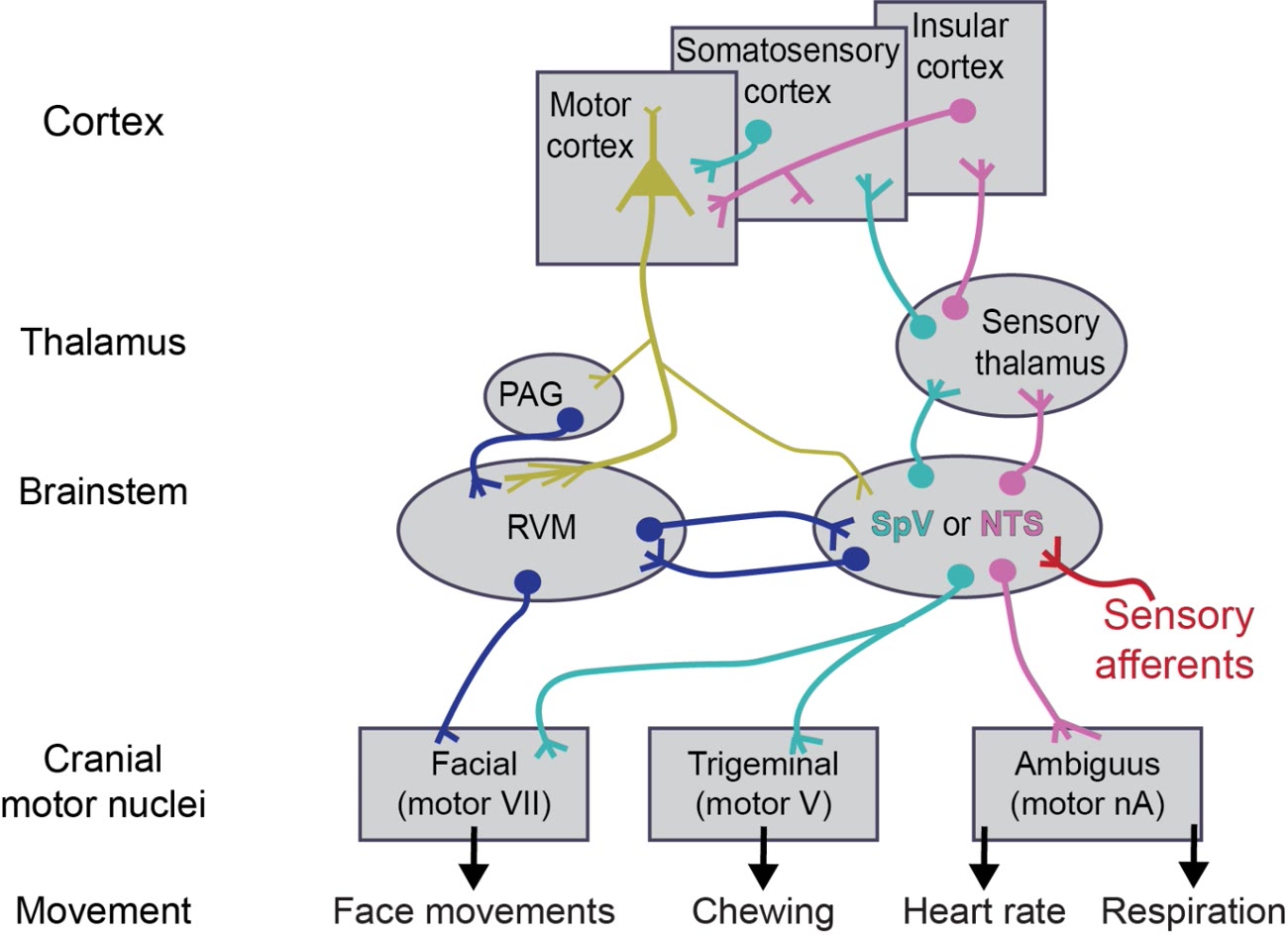
Chronic pain arises from complex interactions between sensory input, motor output, and neuromodulatory signaling that span the entire neuraxis — from cortex to brainstem. We use high-density electrophysiology, causal circuit manipulation, and quantitative behavior to understand how motor circuits engage endogenous opioid systems to control pain, and to translate those mechanisms into new neuromodulatory and pharmacologic therapies.
Our basic science mechanistic studies create a foundation for understanding pain and opioid biology that we use to rationally design and optimize neuromodulatory and pharmacologic treatment strategies.
From single synapse to whole-animal behavior
We combine viral circuit tracing, high-density electrophysiology, optical imaging, causal neuromodulation, and machine-learning-based behavior tracking to connect molecular mechanism to circuit function to behavior.
Circuit Mapping & Connectivity
Anterograde and retrograde viral tracing, transsynaptic labeling, and monosynaptic rabies mapping to define anatomically precise, cell-type-specific circuits from cortex to brainstem.
High-Density Electrophysiology
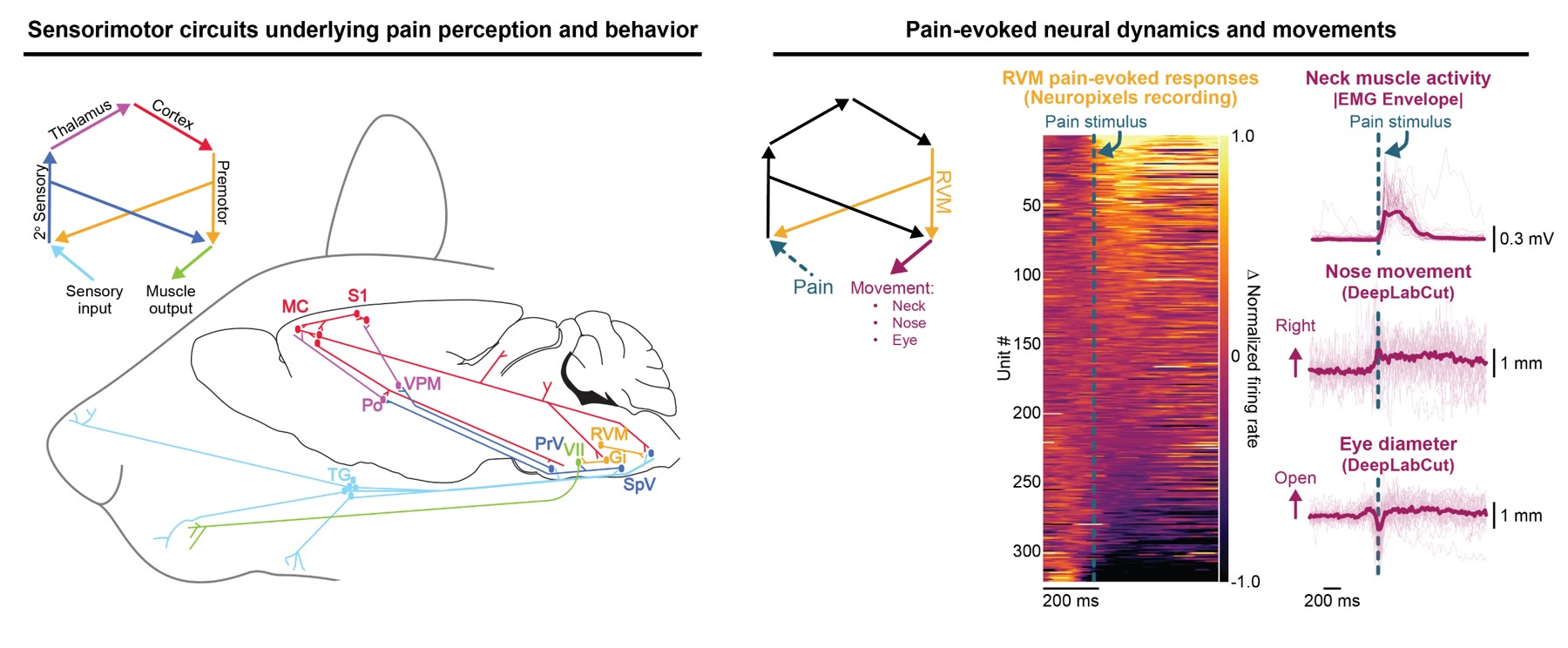
Neuropixels recordings across cortex, thalamus, and brainstem to capture population-level neural dynamics during pain states and neuromodulatory intervention, in awake, behaving mice.
Neuromodulation & miniTMS
Custom-engineered miniaturized transcranial magnetic stimulation (miniTMS) devices to causally probe motor-cortex-driven analgesia in freely moving mice, alongside optogenetic and chemogenetic tools.
Pharmacological & Genetic Manipulation
Systemic and site-specific opioid receptor agonists/antagonists, conditional knockouts, and intersectional genetic strategies to dissect receptor-subtype-specific contributions to circuit function.
Behavioral Tracking
Markerless pose estimation (DeepLabCut), EMG, and validated pain assays to quantify orofacial, limb, and autonomic responses with millisecond precision.
Calcium Imaging
In vivo two-photon microscopy, widefield one-photon imaging, and miniscope recordings to track activity of genetically defined neural populations across learning, pain states, and pharmacological manipulation.
Two converging research programs
Chronic pain, neuromodulation, and systems neuroscience
We investigate how motor cortex engages descending, opioid-dependent circuits to control pain. Using custom-engineered miniaturized transcranial magnetic stimulation (miniTMS) devices, we causally stimulate motor cortex in freely moving mice to drive potent, opioid-receptor-dependent analgesia. By combining this neuromodulatory approach with Neuropixels ensemble recordings, viral circuit tracing, and quantitative behavior, we are mapping the somatotopic organization and population-level dynamics that link cortical stimulation to pain relief — work that builds the mechanistic foundation for optimizing non-invasive brain stimulation as a non-addictive treatment for chronic pain.
Opioid receptor function in brainstem sensorimotor circuits
A second, complementary program asks how opioid receptors expressed within brainstem sensorimotor circuits shape vital physiological functions beyond pain. We map μ, δ, κ, and nociceptin receptor architecture onto specific brainstem nuclei and combine this with electrophysiology, imaging, and behavior to understand how endogenous and exogenous opioids influence the coordination of respiration, heart rate, and orofacial movement — circuits whose disruption underlies serious opioid side effects such as respiratory depression.
Nested cortico-thalamo-brainstem loops
Across both research programs, we conceptualize pain and autonomic control as emerging from nested loops connecting cortex, thalamus, and brainstem to cranial and spinal motor nuclei. Endogenous opioid signaling acts at multiple nodes within these loops, providing several tractable targets for both understanding disease mechanism and designing precision neuromodulatory or pharmacologic interventions.
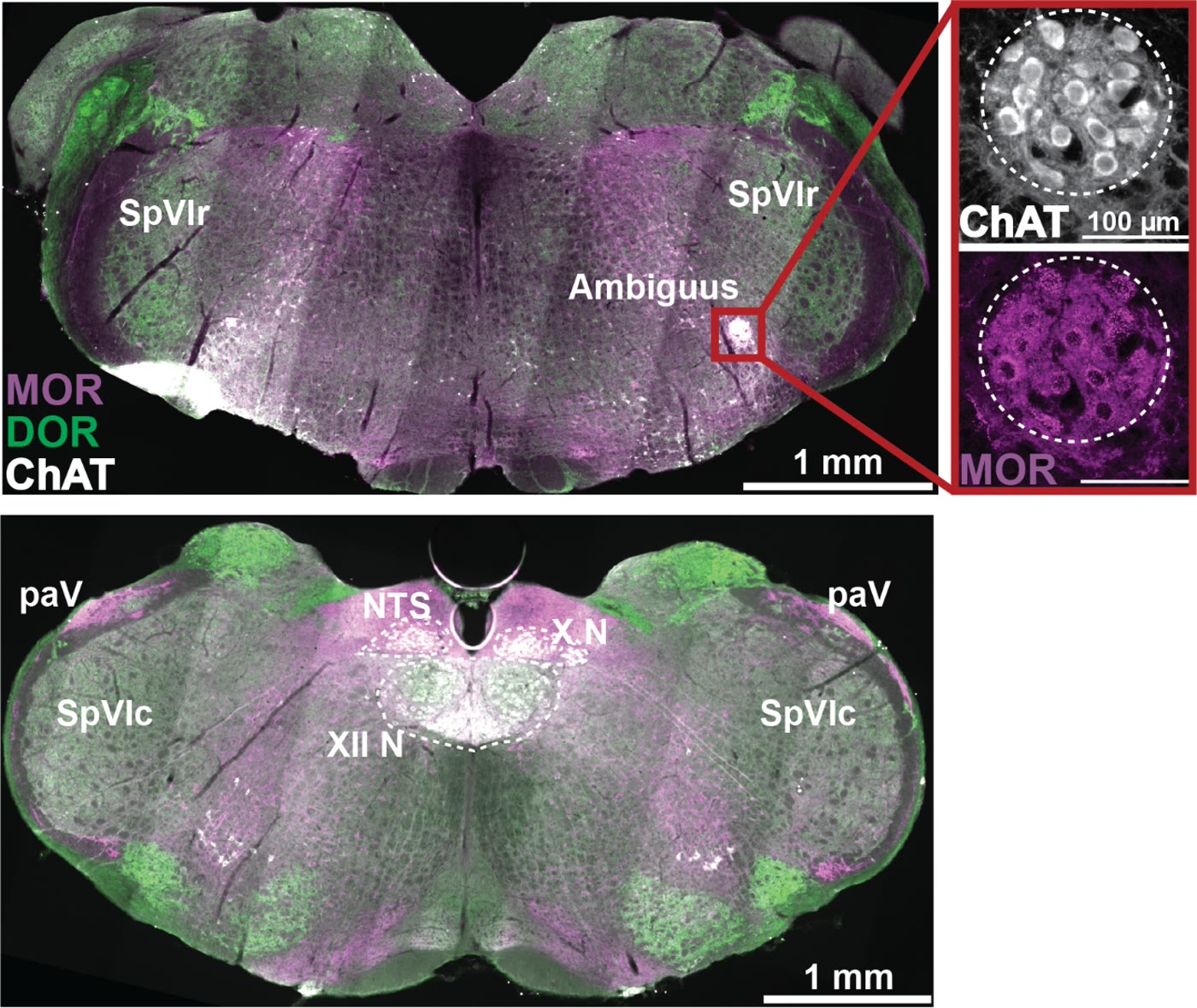
Mapping receptor subtypes onto function
Mu, delta, kappa, and nociceptin opioid receptors are differentially expressed across brainstem and forebrain nuclei. We combine immunofluorescence, in situ hybridization, and viral genetic tools to map this receptor architecture onto the specific circuits and cell types that drive descending pain control, providing a molecular blueprint for targeted pharmacology.
Want to dig into the details?
See our publications for full methodological detail, or get in touch to discuss collaboration.
Papers & preprints
Our published and in-progress work on motor cortical circuits, brainstem opioid receptor architecture, and the translation of circuit mechanism into pain therapeutics.
Preprints
Layer 5 anterior cingulate cortical neurons engage dorsolateral periaqueductal gray excitatory neurons to facilitate the affective component of pain
Kaslow J, McCallum WM, François A, Corder G, Kremer EJ, Ritola KD, Mercer Lindsay N, Scherrer G. bioRxiv 2026.08.24.746788.
View on bioRxivOpioid- and NMDA-receptor-dependent neural plasticity mediates long-term analgesia from motor cortical stimulation
Mercer Lindsay N, Haziza S, Mackey S, Baer TM, Scherrer G, Schnitzer MJ. bioRxiv 2026.07.01.735554.
View on bioRxivOpioid receptor architecture for the modulation of brainstem functions
Mercer Lindsay N*, Hug NF*, McCallum WM, Bryan J, Huang KL, Ochandarena NE, Tassou A, Scherrer G. bioRxiv 2022.12.24.521865. *Equal contribution.
View on bioRxivPeer-Reviewed Publications
Brain circuits for pain and its treatment
Mercer Lindsay N, Chen C, Gilam G, Mackey S, Scherrer G. Science Translational Medicine 13(619):eabj7360.
DOI: 10.1126/scitranslmed.abj7360Orofacial movements involve parallel corticobulbar projections from motor cortex to trigeminal premotor nuclei
Mercer Lindsay N, Knutsen PM, Lozada AF, Karten HJ, Kleinfeld D. Neuron 104(4):765-780.e3.
DOI: 10.1016/j.neuron.2019.08.032Countering opioid side effects
Mercer Lindsay N, Scherrer G. Science 365(6459):1246-1247.
View on PubMedVibrissa self-motion and touch are reliably encoded along the same somatosensory pathway from brainstem through thalamus
Moore JD, Mercer Lindsay N, Deschênes M, Kleinfeld D. PLOS Biology 13:e1002253.
View on PLOS BiologyRecent presentations
- Pain Mechanisms and Therapeutics Conference, Verona, Italy — May 2026
- Rockefeller University Seminar Series, New York, NY — May 2025
- European Pain Federation (EFIC) Congress, Lyon, France — April 2025
- International Narcotics Research Conference (INRC), Ann Arbor, MI — July 2024
Questions about our work?
Reach out to discuss the science, request a reprint, or explore collaboration opportunities.
Meet the lab
The Mercer Lindsay Lab is an early-stage, growing research group at the intersection of systems neuroscience, pain biology, and translational neuromodulation.
Nicole Mercer Lindsay, PhD
Assistant Professor, Departments of Neurosurgery and Anesthesiology, Weill Cornell Medicine · Director of the Laboratory for Systems Neuroscience in Pain and Movement Circuitry
Dr. Mercer Lindsay leads a research program dedicated to understanding how motor circuits and the brain's endogenous opioid system interact across the neuraxis to control pain, with the goal of designing new, non-addictive neuromodulatory and pharmacologic treatments. She holds an active NIDCR K99/R00 award supporting this work.
Independent Investigator, Weill Cornell Medicine — Departments of Neurosurgery and Anesthesiology
Director of the Laboratory for Systems Neuroscience in Pain and Movement Circuitry. Principal Investigator of an active NIDCR R00 grant (2022–present) studying opioid-receptor-dependent mechanisms of motor-cortex-driven pain relief.
Independent Investigator, Burke Neurological Institute
Established an independent research program studying circuit mechanisms of motor-cortex-driven analgesia, supported by an active NIDCR R00 grant.
Postdoctoral Fellow, Stanford University & UNC Chapel Hill
Advisors: Mark Schnitzer & Grégory Scherrer. Mapped brainstem opioid receptor architecture and uncovered circuit mechanisms of motor-cortex-driven analgesia using miniaturized TMS and large-scale electrophysiology.
PhD in Neurobiology, UC San Diego
Advisor: David Kleinfeld. Dissertation: “Cortex drives orofacial behaviors through distinct brainstem networks.”
BA in Biological Sciences, Cornell University
Undergraduate training in biological sciences, laying the foundation for a career in systems neuroscience.
We're building the lab — come build it with us
We welcome inquiries from prospective postdoctoral fellows, graduate students, and undergraduates interested in systems neuroscience, pain biology, and neuromodulation. As an early-stage lab, trainees have the opportunity to help shape new research directions and gain broad exposure to circuit tracing, electrophysiology, imaging, and behavioral methods.
If you are motivated by rigorous mechanistic science with a clear translational goal — developing better, non-addictive treatments for chronic pain — we would love to hear from you.

Get in touch
Whether you're a prospective trainee, a potential collaborator, or interested in our science, we'd love to hear from you.
Address
Weill Cornell Medicine
1300 York Avenue
New York, NY 10065
Affiliation
Weill Cornell Medicine, Departments of Neurosurgery & Anesthesiology
Response Time
We aim to respond to inquiries within one week — thank you for your patience.
Interested in joining the lab?
We welcome inquiries from prospective postdoctoral fellows, graduate students, and undergraduates.